
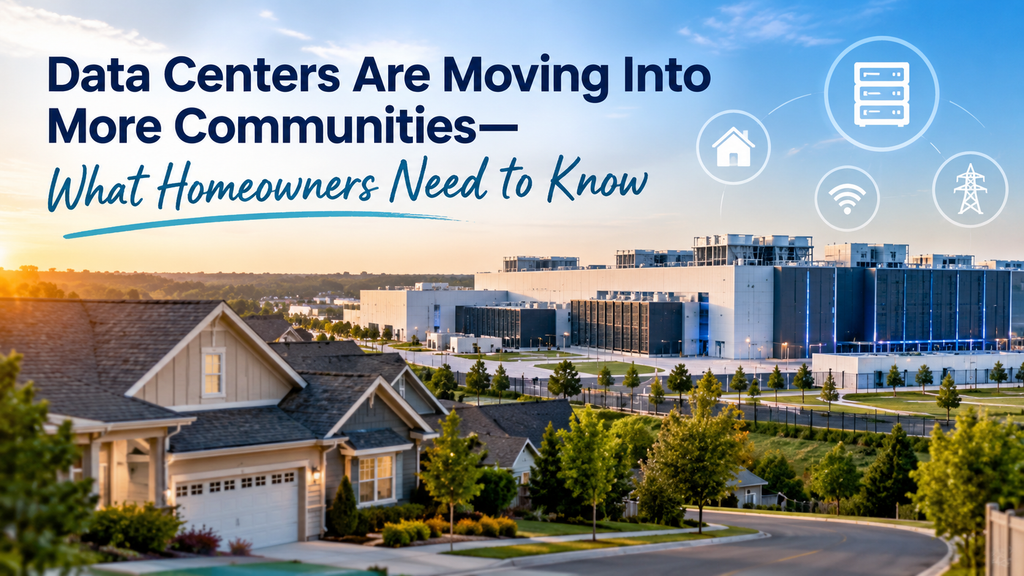
When buying or selling a home, most people think about the neighborhood, school district, commute, nearby amenities, and how close they are to family and friends.
A nearby data center usually isn’t high on that list.
But that is beginning to change.
As data center development grows across the country, more homeowners and homebuyers are wondering how these large facilities might affect the communities around them. Common questions involve property values, utility costs, traffic, noise, infrastructure, and future development.
There is no simple answer that data centers are either “good” or “bad” for a neighborhood. Their impact can vary widely depending on the location, how close the facility is to nearby homes, and how the surrounding area develops over time.
Data Centers Are Becoming More Common
Data center development has increased significantly over the past decade.
In 2015, large data centers were concentrated in a relatively small number of ZIP codes. By 2026, their presence had expanded considerably, with more projects planned as demand for cloud computing, digital services, and artificial intelligence continues to increase.
For the housing market, that means more buyers may find themselves evaluating properties located near existing or proposed data centers.
Homeowners may also begin hearing more about planned data centers, substations, transmission lines, and other infrastructure projects in or near their communities.
Whenever a major development comes to an area, it is natural to consider how it could affect both quality of life and property values.

Can a Data Center Affect Your Home’s Value?
For many homeowners, property value is one of the biggest concerns.
Having a data center nearby does not automatically mean that home values will fall.
Research comparing communities with large data centers to similar areas without them has generally shown that home prices may continue to follow similar broader market trends.
However, every property and neighborhood is different.
A home located directly next to a large facility may be viewed differently by buyers than a home several miles away. Factors such as noise, visibility, traffic, nearby electrical infrastructure, construction activity, and the possibility of future expansion may all influence buyer perceptions.
Distance matters: how buyers may view a nearby data center
The closer a home is to the facility, the more directly buyers may notice its effects.
Rather than assuming a data center will have a certain effect simply because it is nearby, it is more useful to evaluate the specific circumstances surrounding the property.
Data Centers May Bring Benefits to a Community
Large development projects can also bring significant investment into an area.
Data centers may generate substantial property tax revenue, which can help local governments fund public services, infrastructure, and community improvements.
Their development may also lead to upgrades to roads, electrical systems, fiber networks, and other utilities.
In some communities, data center investment can encourage broader economic development by attracting other businesses and supporting additional commercial activity.
Over time, that growth may create jobs, benefit local businesses, and contribute to greater demand for housing.
For homeowners, the arrival of a data center may therefore be only one part of a much larger development trend taking place in the area.
There Are Also Tradeoffs to Consider
As with any large-scale development, data centers can create concerns as well.
These facilities are often sizable, and their design and footprint can alter the appearance and character of the surrounding area.
Construction, truck traffic, cooling systems, and backup generators may add noise. New substations, transmission lines, and other electrical infrastructure may also become more noticeable within the community.
Utility demand is another factor to consider.
Data centers can use large amounts of electricity, and some facilities also require significant water resources for cooling.
That does not automatically mean nearby homeowners will see an immediate increase in their utility bills. However, rising demand can be one of several factors that affect future utility costs.
The actual impact will depend on local regulations, utility agreements, infrastructure investments, and how those costs are distributed among customers.
Potential benefits
- Property tax revenue for local services
- Upgraded roads, power, and fiber networks
- New businesses and commercial activity
- Jobs and support for local businesses
- Greater demand for housing over time
Potential tradeoffs
- Large buildings that change the area’s character
- Noise from construction, trucks, and generators
- More visible substations and power lines
- High electricity and water demand
- Possible pressure on future utility costs
If You’re Buying a Home Near a Data Center
If you are considering purchasing a home near an existing or proposed data center, it may be worth doing additional research before making an offer.
- Determine how close the property is to the facility and whether additional construction or expansion is planned nearby.
- Visit the neighborhood at different times of day to note traffic patterns and noise levels.
- Check how visible the facility, power lines, substations, or other infrastructure are from nearby properties.
- Review local zoning proposals, construction plans, utility projects, road improvements, and other planned developments.
This information can help you better understand what living in the neighborhood is like today and how it may change in the years ahead.
If You’re Selling a Home Near a Data Center
If your property is located near a data center, there is no need to automatically assume that the facility will lower your home’s value or make it harder to sell.
Some prospective buyers may have questions, but clear and accurate information can help address many concerns.
Knowing the facility’s location, construction timeline, expansion plans, traffic patterns, and potential noise levels can help you have more informed conversations with interested buyers.
Because every buyer will weigh these factors differently, it is also important to understand how your property compares with other homes in the immediate area.
What Homeowners and Buyers Should Consider
Real estate is highly local.
A headline about how data centers are affecting housing in another part of the country may have little connection to what is happening in your own neighborhood.
If a data center is already nearby or a new one is being proposed, focus on the details that are most relevant to your property.
Consider how close the facility is, whether expansion is planned, whether roads and utilities are being upgraded, and whether residents are noticing changes in traffic or noise. It is also useful to look at how nearby homes are actually performing in the local market.
Those details can provide a much clearer picture than broad assumptions about data centers as a whole.
Bottom Line
Data centers are becoming a more visible part of the real estate landscape, and homeowners and buyers are likely to encounter them more often in the years ahead.
However, the presence of a data center alone does not determine whether a neighborhood is desirable or whether a particular home is a good investment.
The potential impact depends on the property itself, its distance from the facility, future development plans, local infrastructure, and how buyers in that specific market respond.
If a data center is already located near your home—or one is being proposed in your community—reviewing local market conditions and development plans can help you better understand what it may mean for your property and your next real estate decision.